
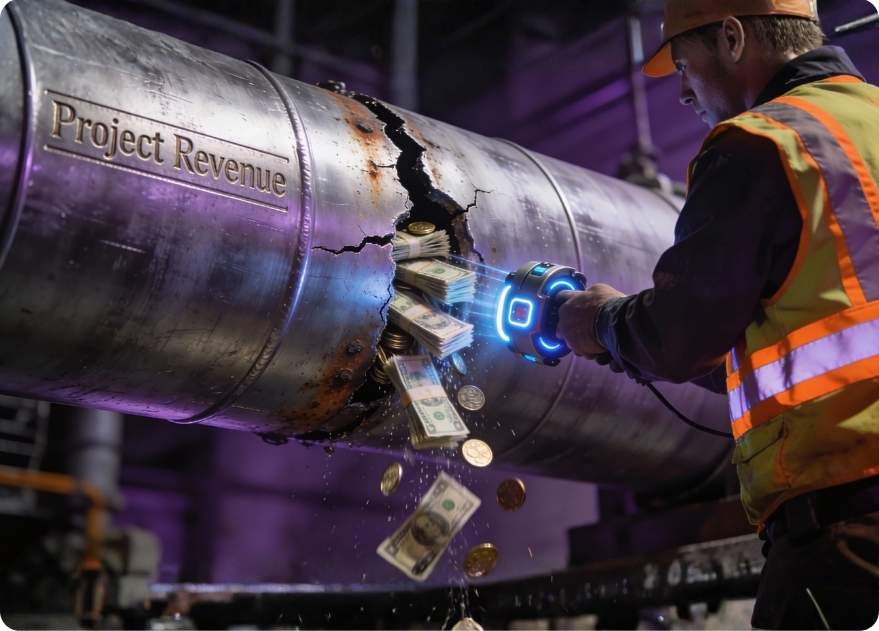
In construction, profit is not lost all at once. It erodes.
A missed variation here.
A delayed cost there.
A subcontractor claim that slips through unchecked.
Procurement commitments raised just outside commercial visibility.
Individually, these issues feel manageable. Collectively, they quietly dismantle margin.
This is margin leakage in construction; not dramatic, not sudden and rarely visible until it’s too late to recover. A Project Management Institute (PMI) study of 258 major international transport infrastructure projects found that actual costs overran original estimates by an average of 28%, yet most of that loss is not driven by headline overruns. It comes from cumulative, poorly controlled commercial decisions made during delivery.
For commercial teams, the challenge is not understanding risk. It is acting on it early enough to matter.
What Exactly Is Margin Leakage in Construction? A Clear Commercial Definition
Margin leakage occurs when the profit margin realised at project completion is lower than the margin assumed at contract award.
Not because the bid was reckless.
Not because the team underperformed.
But because delivery decisions slowly diverged from commercial control.
How a “Healthy” Margin Quietly Slips
- Contract value: £5,000,000
- Target margin: 8%
- Expected profit: £400,000
Now introduce four common, individually “non-critical” issues:
Issue Cost Impact
Missed minor variation £35,000
Subcontractor claim approved late £40,000
Plant overruns (8 extra weeks) £28,000
Preliminaries drift £22,000
Total margin leakage £125,000
Revised profit: £275,000
Actual margin: 5.5%
Nothing catastrophic happened. Yet 31% of expected profit disappeared.
That is margin leakage in construction.
Common Symptoms Commercial Teams See Too Late
- Variations identified late or valued after costs are already incurred
- Subcontractor claims progressing faster than commercial assessment
- Procurement commitments raised outside approved budgets
- Preliminaries and plant costs drifting unnoticed month by month
- CVRs reflecting historic performance rather than current commercial risk
This pattern is well documented across global infrastructure delivery. A study of 258 major international transport infrastructure projects found that actual costs overran original estimates by an average of 28%. Reasons for these overruns included poor project definition, incomplete information, poor productivity, inadequate communications and uncertainties around labor and material costs. By the time margin loss appears in a formal CVR, recovery options are often limited.
The Five Hidden Culprits Behind Margin Leakage in Construction
Margin leakage rarely announces itself. It hides in routine processes that feel “under control” until they aren’t.
1. The Estimation Accuracy Gap: Starting on Shaky Ground
Most margin leakage begins before site mobilisation. Not through bad intent, but through estimates built on:
- Outdated productivity assumptions
- Historic averages that ignore current conditions
- Optimism driven by competitive bidding pressure
When the baseline is fragile, every deviation becomes margin loss. Even small estimating gaps compound quickly during delivery, especially when live performance data is not fed back into forecasts.
2. The Change Recognition Gap: When Extra Work Goes Unpaid
Change should be commercially neutral or positive. In reality, it is one of the biggest drivers of margin leakage. But, the issue is not change itself. It is late recognition.
The Cost of Delayed Change Capture
A change requires:
- 120 labour hours @ £55/hr = £6,600
- Additional materials = £4,400
Total change value: £11,000
If logged immediately, priced, approved and instructed, the value is recoverable. If recognised six weeks later:
- Labour already expensed
- Materials already consumed
Only £3,000 is recovered.
Unrecovered cost: £8,000
Margin impact: permanent
Research examining construction cost factors found that poor contract planning and monitoring, combined with change order problems, explain a significant portion of cost overruns in construction projects. Project management emerged as the most influential factor, particularly in areas of change orders and construction error management.
Suggested Read: Closing the Change Management Gap in Construction ERP
3. The Productivity Paradox: Busy Sites, Bleeding Margins
Construction sites are rarely idle. But activity does not equal productivity.
Labour inefficiencies hide in:
- Waiting time
- Rework
- Poor sequencing
- Unplanned overtime
How Small Productivity Losses Become Big Margin Losses
- Budgeted labour hours: 10,000
- Average labour rate: £60/hr
- Budgeted labour cost: £600,000
A 10% productivity drop pushes actual hours to 11,111.
Revised labour cost: £666,660
Overrun: £66,660
On a project targeting £300,000 profit, that is over 22% of margin lost, without a single dramatic failure. US construction labour productivity declined at an average rate of 1% per year between 1970 and 2020. Over the same period, aggregate labour productivity across the wider economy increased by 290%.
Suggested Read: Real-Time Collaboration in Construction ERP
4. The Time-Based Cost Trap: Prelims, Plant and Silent Drift
Time is one of the most underestimated cost drivers in construction. Preliminaries, plant hire and temporary works accumulate quietly, especially when programmes slip incrementally rather than dramatically.
When Time Alone Erodes Margin
Weekly preliminaries: £18,000
Programme slip: 6 weeks
Additional preliminaries cost:
£18,000 × 6 = £108,000
On a project targeting £350,000 profit, that delay removes 31% of expected margin.
Project delays have cascading effects on time-based costs, particularly when slippage occurs gradually rather than through a single identifiable event.
5. The Reporting Time Lag: Seeing the Problem Too Late
Perhaps the most dangerous culprit is not cost itself, but when cost becomes visible.
Many commercial teams operate with:
- Monthly CVRs
- Delayed subcontractor cost data
- Retrospective productivity insights
Why Late Data Multiplies Loss
A productivity issue costs £2,500 per week.
If flagged immediately: £2,500 impact
If flagged at month-end: 4 weeks × £2,500 = £10,000
Same issue. Same site. Same people. Timing is the difference between correction and compounding loss. Inadequate communication and delayed information flow allow issues to escalate before corrective action is possible.
How Commercial Teams Can Reduce Margin Leakage in Construction
Reducing margin leakage in construction requires a shift from reactive correction to proactive control. The most effective commercial teams change how decisions are informed, not just how often numbers are reviewed.
Move from retrospective CVRs to live control
Live commercial control means:
- Job-to-date visibility across all cost categories
- Earned value measured against committed and forecast cost
- Variances identified while action is still possible
When CVRs update in real time, commercial teams can intervene earlier; adjusting procurement, renegotiating scope or escalating risk before margin is lost.
Capture change at the moment it happens
Every change event has a commercial impact. The difference between recovery and leakage is timing.
Effective teams ensure:
- Change is logged as soon as it occurs
- Cost and value impact is assessed immediately
- Commercial approval workflows are enforced consistently
Lock procurement to commercial rules
Procurement must operate within commercial guardrails.
This includes:
- Budget-linked approvals
- Visibility of committed spend at the point of order
- Automatic escalation when thresholds are breached
When procurement and commercial teams work from the same data, cost decisions support margin protection rather than undermine it.
Suggested Read: The Snowball Effect in Construction Procurement
Create a single version of margin truth
Margin leakage thrives on ambiguity.
A single source of truth ensures:
- Commercial, finance, and delivery teams see the same numbers
- Forecasts are trusted across the organisation
- Accountability is clear when margin moves
Fragmented reporting encourages debate about data instead of decisions about action.
How Xpedeon Turns Commercial Control Into a Daily Discipline
Reducing margin leakage in construction is not about adding more reports or reviews. It is about embedding commercial control into the way work actually happens, across procurement, subcontractor management, cost capture and forecasting.
This is where platforms purpose-built for construction make a measurable difference.
Xpedeon brings commercial, finance and supply chain workflows into one connected system, allowing teams to:
- Maintain job-to-date cost and value visibility, not retrospective snapshots
- Capture change at source and assess commercial impact immediately
- Align procurement commitments directly to budgets and forecasts
- Run live CVRs that surface risk early, while corrective action is still possible
By removing blind spots between site activity and commercial reporting, Xpedeon helps teams move from margin recovery to margin protection, shifting commercial control from a monthly exercise to a daily discipline.
What Changes When You Reduce Margin Leakage in Construction
When margin leakage is controlled, the impact is felt beyond the commercial function.
- CVRs take hours, not weeks
- Forecasts drive decisions, not explanations
- Disputes reduce as audit trails improve
- Commercial teams focus on strategy instead of reconciliation
- Leadership gains confidence in portfolio-level performance
Most importantly, margin becomes something the business actively manages; not something it hopes to preserve.
From Margin Recovery to Margin Protection
Many construction businesses focus on margin recovery, clawing back value after slippage is identified. The strongest performers focus on margin protection.
This shift changes how teams operate:
- Risks are flagged early, not justified late
- Forecasts are challenged continuously
- Commercial governance becomes part of daily delivery
Margin protection is not about control for its own sake. It is about predictability.
Conclusion
Commercial teams understand margin risk. They see it every day. What fails them is not effort or expertise, but fragmented systems that delay visibility and dilute accountability. To reduce margin leakage in construction, businesses must address how data flows, how decisions are governed and how quickly risk is surfaced.
Margin loss is rarely sudden. It is cumulative. The organisations that protect profitability are those that build commercial control into everyday workflows - long before margin is at risk.
Learn how construction businesses are building commercial control into live project delivery. Book a Discovery Call Today!