
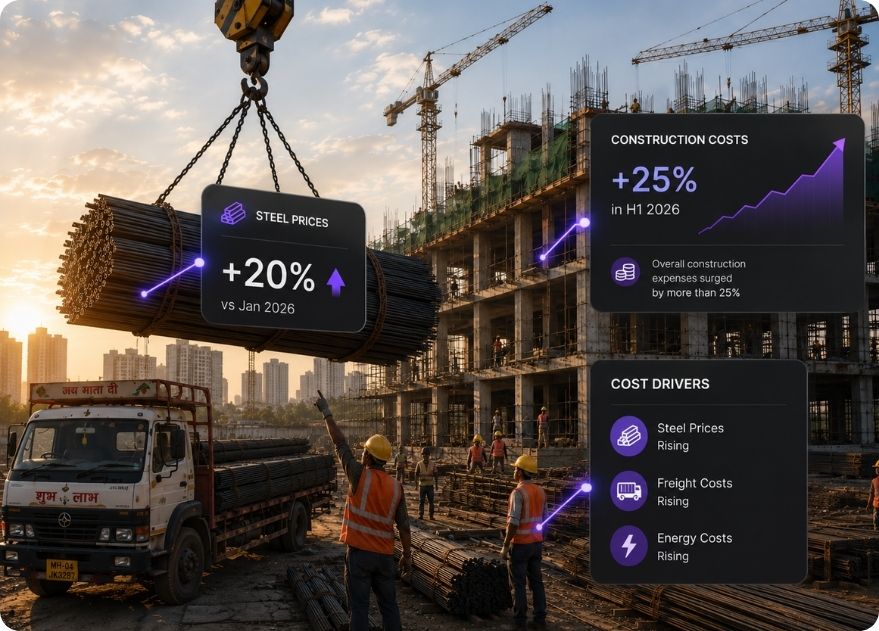
Rising construction costs in India in 2026 are no longer a distant risk sitting in a forecast. They are already showing up on live project accounts. According to the GRI report, construction expenses surged by more than 25% during the first half of 2026, pushed up by an energy shock, a shipping squeeze and a sharp jump in steel prices.
For contractors, developers and commercial teams, the real question is not whether costs have risen. It is whether your budgets and cost tracking already reflect this shift, or whether you are still working off numbers set before the ground changed under you.
What is Driving Rising Construction Costs in India in 2026
The story starts outside the construction sector, with an energy shock that hit the whole economy. Conflict in the Middle East disrupted shipping through the Strait of Hormuz, the corridor that carries a third of the world's oil, sending Brent crude above USD 100 a barrel. India imports 90% of its crude, so the price spike moved straight into domestic energy costs. Drone attacks on LNG shipments cut industrial gas supply by up to 30%, and the rupee came under pressure as capital moved out of Indian markets. The effects quickly filtered through to construction projects via higher energy, freight and material costs.
The freight and steel squeeze
Shipping was the next domino. Vessels rerouted around the Cape of Good Hope faced transit delays of up to 20 days and freight increases of up to INR 350,000 per container. That alone added 15 to 18 percent to domestic logistics costs. Steel followed close behind, rising 20 percent to INR 72,000 per tonne, which added roughly INR 50 per square foot to high-rise developments. For a contractor running several live sites, that is not a rounding error. It is a material change to the cost base of every open contract.
The number that sums it up
Put together, these pressures pushed overall construction expenses up by more than 25%, according to the GRI Institute's Anchoring the Future: Indian Real Estate Outlook H2 2026 report. The same report tracks industry sentiment falling from a score of 60 in late 2025 to 49 in the first quarter of 2026, a clear signal that the pressure was felt across the sector and not confined to one segment or region.
The Real Estate Outlook Behind Rising Construction Costs in India
Rising construction costs in India have not stalled the market. They have redirected it. According to the GRI Indian Real Estate Outlook H2 2026 report, domestic investors, family offices and alternative credit have played an increasingly important role in supporting deal activity as foreign institutional investment slowed. At the same time, government-backed initiatives such as the INR 1 trillion Urban Challenge Fund are pushing growth into Tier-2 and Tier-3 cities, where land prices are forecast to rise between 25 and 100 percent over the next two to four years.
This matters for anyone pricing work in India right now. Growth has not paused. It has simply moved toward newer markets, retrofitting programmes and ESG-compliant assets, all of which still need to be delivered against a construction cost base that looks nothing like it did twelve months ago.
Where the pressure and the opportunity both sit
Gross office leasing across India's top seven cities reached 35.7 million square feet in the first half of 2026, a 6% year-on-year increase, with Global Capability Centres driving much of that demand. Southern markets, led by Bangalore, Hyderabad and Chennai, captured almost three-quarters of GCC leasing. For contractors delivering this pipeline, rising construction costs in India mean the volume of work has not slowed even as the cost of delivering it has climbed. That combination puts commercial teams under more pressure, not less, to keep every project accurately costed as work scales into new cities and asset types.
What Rising Construction Costs in India Mean for live Projects
- Projects priced in late 2025 are already running on outdated cost assumptions
- A CVR built on last quarter's steel rate or freight assumption is not a snapshot of risk, it is a blind spot
- Subcontractors on fixed-price packages carry the same exposure
- That pressure travels up the supply chain fast, landing on the main contractor's margin the moment a claim or variation appears
- The RBI held the repo rate at 5.25% through this period, keeping borrowing predictable and supporting developer confidence
- Stable rates help on the financing side, but do nothing to offset a steel bill that arrived 20% higher than the original budget
- Cost control, not interest rates, is what protects margin when input prices move this fast
- Unlisted and mid-market developers feel this most directly
- That gap makes accurate, current cost data a competitive issue, not just a commercial one
- A developer who can show a lender or JV partner a live, defensible cost position negotiates from a stronger place than one working off a spreadsheet that is weeks old
How to Protect Margins Against Rising Construction Costs in India
Real-time cost tracking beats a static budget
A CVR that is accurate for the day it was compiled and stale two weeks later cannot catch a cost shift this size before it erodes margin. Xpedeon's construction cost value reconciliation software gives commercial teams live visibility of budget, committed cost and forecast, so a steel price move or a freight surcharge shows up in the numbers immediately, not at the next reporting cycle.
Procurement visibility stops surprises at delivery
When freight and material rates are moving month to month, procurement cannot run on assumptions set at tender stage. Xpedeon's construction procurement software connects every purchase order to current supplier pricing and budget position, so commercial teams see the impact of a rate change before it is committed, not after the invoice lands.
Job costing that reflects today's rates
In 2026, rising construction costs in India make it essential to track labour, materials, plant and subcontractor costs against live rates rather than the numbers set at project start. Xpedeon's job costing software connects budgets, actuals and forecasts in one system, giving finance and commercial teams a shared, current view of where every project stands.
Compliance still has to hold while costs shift
Cost pressure does not suspend regulatory obligations. Material movements across Indian sites still require valid e-way bills, and construction accounting still needs to account for TDS and other statutory deductions correctly, even as procurement volumes and values change with rising costs. Xpedeon's guide to e-way bill compliance for construction materials in India and its complete guide to construction accounting software cover what changes and what does not.
The Bottom Line on Rising Construction Costs in India in 2026
The macro picture behind rising construction costs in India in 2026 is not one of retreat. It is one of adjustment. Domestic capital is filling the gap left by cautious foreign investors. Growth is moving into Tier-2 and Tier-3 markets. Retrofitting and ESG-compliant assets are commanding premium rents. None of that changes the fact that a budget built on last year's steel and freight numbers is already wrong.
Contractors who come out of this period with margins intact will be the ones tracking cost in real time, not the ones waiting for month-end to find out what changed. If your CVR, procurement and job costing still run on numbers from before this shift, now is the time to close that gap.