
It's easy to think of approval delays as an inconvenience. In reality, they can become an avoidable cost. Material prices don't stand still while purchase orders wait in approval queues. ONS data shows construction material prices rose 5.4% in the year to May 2026, compared with 2.1% in the year to February. When prices are increasing at a faster rate, even short approval delays can have a measurable impact on procurement costs.
Here's why it matters to procurement specifically. A negotiated quote carries a validity period, commonly two to four weeks. Materials move in price inside that window. The delivery slot a supplier was holding goes to whoever commits first. So, while the requisition waits, the price drifts towards expiry, the slot comes under threat, and the site team plans around a date nobody has confirmed.
Most contractors couldn't tell you how long their approvals actually take. That's the first thing worth fixing, because you can't shorten a delay you've never measured.
The first step isn't changing the workflow. It's understanding how your current process performs.
Measure Your Approval Cycle Before You Try to Improve It
Start by mapping the journey of a purchase request from the moment it's raised to the moment it's fully approved. Then ask three questions of every stage.
- How long does this stage take?
- Where do requests spend the most time?
- Why do they stop there?
Then look at what the delay is doing downstream. Are supplier quotations expiring before approvals complete? Are urgent purchases going around the workflow because the workflow is too slow to use? Are site teams waiting on materials because the order hasn't cleared?
That exercise gives you more than a number. It shows where your purchase order approval workflow is creating friction and which bottleneck to deal with first.
Doing it manually means reconstructing the story from emails and spreadsheets. The alternative is a system where the answer is already visible. Xpedeon's Procurement Workbench puts outstanding, approved and next actions on one live screen, with real-time tracking of purchase order status across projects, so you can see where a request currently sits instead of asking who has it. Purchase order summaries and cost variance reporting then show whether what you found was a one-off or a pattern worth fixing.
How long should purchase order approvals take?
There's no published construction-specific benchmark, which is part of why so few contractors measure this at all. APQC's cross-industry data puts strong performers at hours rather than days for issuing a purchase order, with weaker ones around two days, though neither figure accounts for the multi-party sign-off a construction order usually carries.
The more useful test is local to you: do your approvals clear inside your suppliers' quote validity periods? An eight-day approval is comfortable against a thirty-day quote and expensive against a fourteen-day one. That comparison tells you whether you have a problem far better than any industry average will.
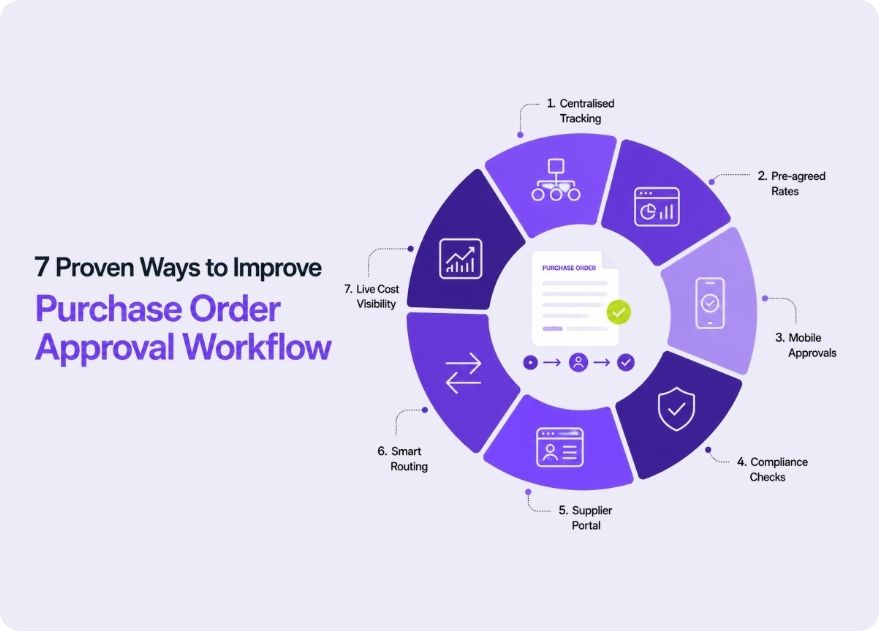
Seven things will move the number, and none of them involve chasing harder.
Seven Workflow Improvements That Remove Approval Delays
Procurement process automation gets talked about as though it means removing people from decisions. But it doesn't mean that. The approvals still happen, by the same people, at the same authority levels. What changes is everything around the decision: how it reaches them, what it arrives with, and whether anyone can see it waiting. Approvals are one part of what construction procurement software covers, and they're usually the part where time goes missing.
The question isn't whether approvals should happen. It's how to make sure they happen without unnecessary waiting. That's where the following seven workflow improvements make the biggest difference.
1. Centralised Approval Tracking in a Single Workbench
Approvals go missing because they're scattered. Some sit in email, some in a finance system, some in a conversation someone had on site. Xpedeon's Procurement Workbench brings them together, so what's outstanding, what's approved and what's next is visible in one place. Approvers can self-allocate tasks and raise queries there too, which matters more than it sounds: a request that prompts a question usually stops dead until someone picks up the phone.
2. Ordering Against Pre-Agreed Rates and Terms
Many purchase orders spend longer in approval than they should because approvers end up questioning prices that have already been negotiated. Instead of checking authority, they're checking whether the rate looks right. Ordering against pre-agreed rates and trading terms removes that uncertainty. The commercial negotiation happens once at framework level, so individual purchase orders become quicker, lower-risk decisions.
3. Mobile Approvals and Digital Sign-Off
Construction approvers are rarely at computers. Xpedeon's mobile app lets them clear approvals from site, and where something needs signing rather than approving, the DocuSign integration captures legally binding sign-off from any device. No printing, no waiting for someone to be back in the office on Monday.
"Our approvers are just busy" is the usual explanation for slow sign-off, and it's only half right. Busy people clear approvals quickly when the request reaches them with everything needed to decide, on the device already in their hand. What they don't clear is a notification buried under two hundred emails that needs a separate system opening to action.
This is often where the biggest improvement comes from. Diyar AlManar, a residential real estate developer based in Saudi Arabia, reduced approval times by 40% after moving to Xpedeon. Reflecting on the change, the team highlighted mobile access and connected workflows as the difference:
"Now, everything's connected, and I can check project costs or approvals instantly."
See more here - Case Studies | Xpedeon
4. Automated Subcontractor Compliance and Expiry Tracking
Here's a delay that never looks like an approval problem. An order is ready, the approver is willing, and then someone notices the subcontractor's insurance lapsed last month. Now it waits on a certificate. In Xpedeon, insurance, certificates and records sit against the supplier's own record, with onboarding status and expiry dates tracked, so a lapse shows up as a warning rather than a surprise at the point of commitment. Suppliers maintain those documents themselves through the portal, which means whether the paperwork is current no longer depends on somebody in procurement remembering to ask.
Suggested Read: The Shift to Subcontractor Compliance Tracking Software
5. Reduce Buyer Interruptions with Supplier Self-Service
A good share of a buyer's week goes on status updates: where's my order, was the invoice received, and has the delivery been confirmed. Through Xpedeon's Supply Chain Portal, suppliers see and respond to orders directly, submit invoices and delivery confirmations, and manage their own compliance documents. The chasing stops in both directions, and the buyer gets time back for the approvals that actually need pushing.
Worth Downloading: Supply Chain Portal Handbook for Construction
6. Route Requests to the Right Approver Automatically
One of the easiest ways to lose time is sending a request to the wrong person. It gets forwarded, redirected or returned for more information before the real approval process even begins.
Xpedeon's configurable approval workflows remove that uncertainty. Purchase requests are automatically routed to the correct approver based on predefined rules such as purchase value, project, cost centre or purchasing category. Supporting documents travel with the request, so approvers have the information they need without asking procurement to fill in the gaps.
The result is fewer manual hand-offs, fewer approval loops and a purchase order approval workflow that moves consistently, regardless of who's raising the request.
7. Live Budget and Committed Cost Visibility
An approval made without knowing what's already committed is half a decision. Because procurement is connected to contracts, budgets, CVR and the financials, the person approving can see the order against the project's cost position rather than in isolation. That speeds things up as much as it protects margin, because that context removes unnecessary back-and-forth with finance, helping approvers make informed decisions without delaying the purchase order.
Can You Speed Up Approvals Without Losing Control?
It's the first question most commercial directors ask, and the honest answer is that it usually tightens governance rather than loosening it.
Your authority limits stay exactly as you set them. Nobody approves anything they couldn't approve before. What changes is that every step is logged as it happens, nothing gets cleared verbally on a site visit and written up later, and the audit trail builds itself rather than being assembled when someone asks for it. Compare that with a manual process run through phone calls and forwarded emails, where the record of who agreed what depends on whether anyone thought to keep it.
Auditors tend to prefer the automated version, which is not the reaction most people expect.
See how your purchase order approval workflow compares. Bring one live project to a 30-minute session and we'll show you where approvals are slowing procurement, increasing committed costs and putting supplier quotations at risk.