
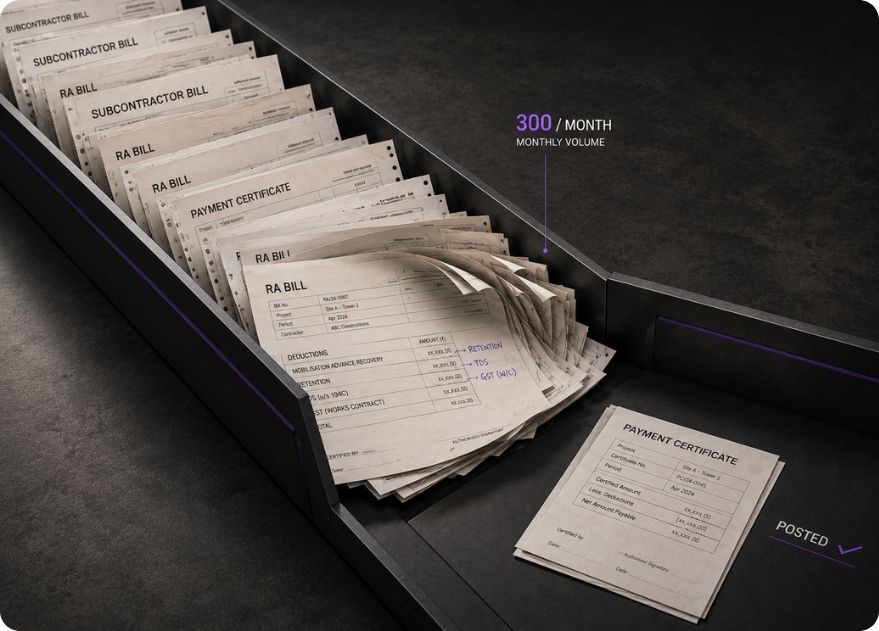
Ask a finance head running four sites how the business is doing, and they can usually tell you. Ask the same question once that number reaches ten, with a dozen subcontractors sending RA bills every week and retention sitting across as many ledgers, and the answer often takes a few days to put together. Somewhere between those two points, accounting software for contractors in India stops being about recording transactions and starts deciding whether anyone can see the business clearly at all.
Part of the reason is that most tools weren't written with construction in mind. They were built for retail or services businesses, where a sale is a sale and an invoice is an invoice, then adapted for contracting later. The adaptation tends to stop short of the parts that matter most, project costing, RA billing, Works Contract GST and TDS under Section 194C.
Choosing accounting software for contractors in India really comes down to whether the system was designed around how contracting work moves, or whether a project field was bolted onto a general ledger and called good enough.
Why Accounting Software for Contractors in India Doesn't Behave like Regular Bookkeeping
A regular accounting tool handles sales, expenses and GST returns well enough. A contracting business needs something more specific, a system that treats every project as its own cost centre and routes purchases, subcontractor payments and labour charges to the right site automatically.
Three things make this genuinely different from standard bookkeeping.
- Running Account bills carry deductions for mobilisation advance recovery, retention and sometimes liquidated damages, all inside a single bill that has to post correctly across several ledgers at once.
- Works Contract GST applies at 12% or 18% depending on the nature of the contract and getting this wrong shows up as an input credit mismatch months later, not immediately.
- TDS under Section 194C has to be deducted correctly on every subcontractor payment and reconciled against Form 26AS at year end, with current provisions available directly from the Income Tax Department.
None of this is unusual for anyone who has run a construction business in India. It's just rarely handled well by software that was designed for a different kind of company.
What Accounting Software for Contractors in India looks like Today
Most businesses don't pick accounting software once and stay with it. They move through tools as the business grows, and each one carries the business a certain distance before something starts to slip.
Tally
Where most Indian contractors start and where a large share of them stay. Set up cost centres for each project, route bills against them, and you have something close to a project-wise P&L that any CA can work with. The trouble shows up at volume. Every RA bill, with its deductions and TDS, has to be typed in by hand, and once a business is processing close to 300 bills a month, entries fall behind. The books are accurate for last month, which isn't the same as being useful this week.
Zoho Books and QuickBooks Online
They solve a different problem well. GST filing is straightforward, the interface is easy for a non-accountant to use, and bank feeds save time on basic reconciliation. What neither one has is a project costing layer built for construction. RA billing doesn't fit a standard invoice template, and once a business is running more than one or two sites, someone ends up rebuilding project profitability in a spreadsheet anyway, right back where they started.
HostBooks
Covers similar ground with a stronger compliance focus, GST, TDS and payroll all handled in the browser without needing a Tally server or an in-house IT setup. It's a genuine option for a small contractor who wants compliance sorted without the overhead. The same gap remains though, project-level cost tracking isn't built into it the way retention and RA billing would need.
Procore
It takes the opposite approach. It's built around connecting site activity, budgets and subcontractor claims, and that link between field and finance is hard to replicate by stitching Tally, Excel and a WhatsApp group together. But Works Contract GST and TDS under 194C sit outside the platform entirely, so a second system for compliance is unavoidable, and that means the reconciliation problem doesn't go away, it just moves to a different join between two systems.
Foundation Software
This goes deeper on construction accounting than almost anything else on this list, job costing by phase, certified payroll, equipment tracking, all native to how a construction business runs. It was built for the US market though, and Indian requirements like Works Contract GST, TDS and PF or ESI compliance have to be handled separately. There's also no established base of Indian CAs trained on it, which adds friction at audit time that a Tally-based setup simply doesn't have.
Each of these tools is good at something. None of them was built around the specific shape of an Indian construction business, project-based costing, RA billing, Works Contract GST and TDS all working together in the same system.
What Changes with a Construction ERP
A purpose-built construction ERP helps with:
- Holds retention, RA billing and TDS at the point a transaction is entered
- Works Contract GST gets applied by contract type without a manual step
- Project-wise profit and loss is there when someone asks for it
This is where Xpedeon sits. Instead of running compliance through one tool and project financials through another, Xpedeon connects procurement, subcontracting and financial accounting in a single system, so an RA bill certified on site updates the project's cost position, GST liability and TDS deduction in the same entry. The finance team stops re-entering the same figures into three different places and starts working from one version of the truth, which is really the whole point of choosing accounting software for contractors in India in the first place.
It changes what a month looks like for a finance team too. The certification of work on site becomes the financial event, not a separate task that finance chases down afterward. That's the real shift from a bookkeeping tool to a construction ERP, seeing the numbers as they happen instead of reconstructing them after the fact.
Matching your Stage to the Right Setup
Not every stage of the business needs the same answer to accounting software for contractors in India. A contractor with one or two projects and a founder who still knows the numbers by heart doesn't need much beyond disciplined spreadsheets or a basic Tally setup, so long as project cost centres are set up properly from the start. Skipping that step is the single most common reason businesses spend months later trying to reconstruct historical project costs they never tracked separately in the first place.
Once an accountant is in place but the system isn't, costs tend to live in Excel, subcontractor payments sit in a register somewhere else, and GST gets reconciled manually each quarter. This is one of the most common stages for growing Indian contractors, and it's also where the gap between what the books say and what a project is earning starts to widen without anyone noticing right away.
If Tally is already in place and the real problem is volume, 200-500 bills a month with deductions to work out by hand, the issue usually isn't the software. It's the manual effort behind it. The books stay technically correct while staying a few weeks behind, which for most decisions is close enough to being wrong.
Once a business is running several projects at once with formal reporting to lenders or clients, accounting software needs to stop being a bookkeeping tool and start acting like project management software with proper financial control built in. This is the point where reconciling site data against financial data by hand stops being something the finance team can keep doing quietly in the background.
What to Check Before Choosing Accounting Software for Contractors in India
A handful of questions tend to separate the tools that hold up from the ones that don't.
- Does the system work out TDS under Section 194C automatically when a subcontractor bill is entered, or does someone still calculate it separately.
- Does it apply Works Contract GST correctly based on contract type without manual setup each time.
- Is retention tracked against each contract with a scheduled release date, or does someone need to remember it.
- Does project-wise profit and loss update as the transactions happen, or only after a manual pull-together at month-end.
If more than one of these needs a workaround instead of being built in, the tool was probably right for where the business was a year ago. It isn't built for where the business is heading.