
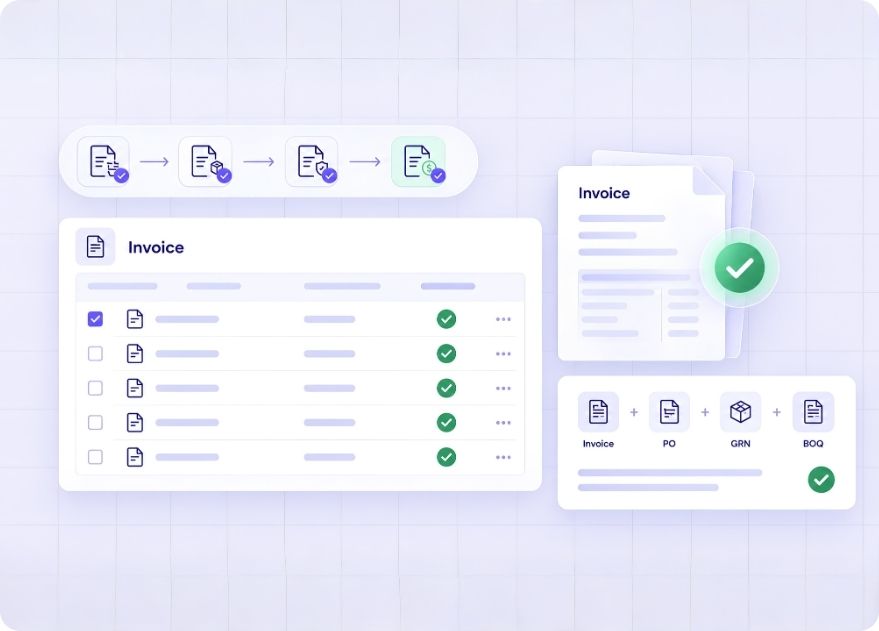
Invoice reconciliation software helps close the gap between what has been billed or claimed on a project and what finance can verify against supporting records. For many GCC contractors, resolving that gap still takes days every month, as teams chase mismatched purchase orders, delivery notes and subcontractor claims across live sites in Dubai, Riyadh and Doha. Spreadsheets and disconnected systems were never built for multi-project, multi-currency construction billing, and the gap resurfaces every month at invoice close.
Generic accounts payable tools rarely close that gap, because most were built for offices buying stationery and services rather than for projects where a single invoice has to be checked against a measurement sheet, a retention schedule and a contract rate negotiated months before the work started. This piece sets out what invoice reconciliation software needs to deliver for GCC construction, and what to check before you shortlist a vendor.
5 Signs your Current Process needs Automated Invoice Reconciliation
Before comparing tools, it helps to be honest about where the current process is failing. A few patterns show up repeatedly in GCC construction finance teams:
- Month-end close routinely slips because reconciliation is still catching up on the previous month's invoices
- Subcontractors chase payment because their claim does not match what the site team measured
- The same invoice gets queried twice because there is no shared record of what was already checked
- Finance cannot say, on any given day, what has been committed versus what has been invoiced across live projects
- Auditors ask for supporting documentation that takes days to pull together instead of minutes
If these issues are recurring, your reconciliation process has likely outgrown spreadsheets and email-based approvals, regardless of how experienced the team running it is.
Why Invoice Reconciliation Breaks down on GCC Construction Projects
Construction invoicing is not a simple two-party exchange. On a live GCC project, an invoice usually needs to be checked against a purchase order, a goods receipt note, an approved bill of quantities rate, and sometimes a measurement sheet signed off by a site engineer. A few things make this harder in the region specifically:
- Construction groups operating across GCC markets often need to manage different tax, invoicing and reporting requirements across entities
- Subcontractor invoices are tied to variable valuation cycles rather than fixed monthly billing
- Retention and advance payment adjustments have to be recalculated on every claim
- Procurement, site, and finance teams often work on separate systems that do not talk to each other
- Multi-entity groups need consolidated visibility without losing project-level detail
Construction billing needs reconciliation workflows that connect project, procurement and finance data. A faster spreadsheet does not fix a structural gap like that.
What Automated Invoice Reconciliation solves
An invoice reconciliation tool built for construction should do more than digitise paperwork. Done well, automated invoice matching and approval changes what finance teams spend their time on:
- Three-way matching runs automatically against the PO, GRN, and approved rate, instead of a controller checking each line by hand
- Exceptions get flagged the moment a value falls outside tolerance, so review time goes to the invoices that need it
- Approval cycles shorten because routing follows project hierarchy instead of email chains
- Every match, exception, and approval is logged, which matters when auditors or clients ask for supporting evidence
- Disputes with subcontractors drop because both sides are working off the same measured values
- Finance leadership gets real-time visibility into committed cost against invoiced value, project by project
That is the practical shift automation makes: less time spent checking every line, more time spent managing the exceptions that actually carry risk.
Core Capabilities to Check before you Shortlist a Tool
Not every invoice automation solution on the market was built with construction in mind. Before you commit budget, check the tool against these capabilities:
Multi-way matching across PO, GRN and BOQ
The system should match invoices against POs, GRNs and BOQ rates together. Skip the BOQ rate and the biggest source of variance on a construction invoice goes unchecked.
To know more about three-way matching, read our Preventing Duplicate and Incorrect Payments in Construction
Subcontractor workflows tied to measurement
In practice, subcontractor claims should reconcile against measurement sheets and approved valuations, tracked separately from standard vendor invoices.
Multi-currency and multi-entity handling
If your group operates across the UAE, Saudi Arabia, and other GCC markets, the tool needs to consolidate reporting without forcing every entity onto a single currency or chart of accounts.
For a closer look at how currency differences affect project reconciliation and group reporting, read our guide to Multi-currency Project Accounting
Compliance readiness for e-invoicing
Regulatory requirements around e-invoicing are moving fast across the region, and reconciliation software should be built to keep pace rather than need a rebuild every time a mandate changes. The UAE's e-invoicing rollout is one example construction finance teams are already tracking closely.
Configurable approval routing
Approval matrices should reflect your project structure and delegation limits, with enough flexibility to handle different entities and approval scenarios.
Native integration with ERP and procurement
Reconciliation data should flow directly from procurement and site systems. A tool that requires manual exports and re-entry just moves the reconciliation problem downstream, and it usually recreates the same version-control issues the new system was meant to remove.
Variance and exception reporting
You need a clear view of what is being flagged, why, and how long exceptions are sitting unresolved. Reports should be readable by project managers as well as finance, since most exceptions get resolved faster with site input.
Audit trail by default
Every match, override, and approval should be timestamped and attributed automatically. When a client or auditor asks how a payment certificate was arrived at, the answer should already exist in the system, pulled from records rather than reconstructed from email threads.
Automated Invoice Reconciliation vs Standard Invoice Automation Solutions
Most invoice automation solutions on the market were built for retail or services accounts payable, where an invoice matches a purchase order and that is the end of the story. Construction billing works differently. Values shift with site measurements, retention is held back and released over months, and a single subcontractor account can carry dozens of open claims across different valuation cycles.
A reconciliation tool bolted onto a standard AP module may process the invoice, but it is unlikely to account for the wider project context behind it. That distinction matters when you are choosing between a point solution and a system built around construction billing from the ground up.
How Xpedeon Approaches Automated Invoice Matching and Approval
Xpedeon builds invoice reconciliation directly into the project data that generates it. Purchase orders, goods receipts, subcontractor valuations, and BOQ rates all sit in one system, so matching happens against live project figures instead of static reference data pulled in from elsewhere. That means:
- Approval matrices are configured per project and per entity, matching how GCC construction groups delegate authority
- Subcontractor invoices can be matched against approved measured work, reducing back-and-forth on disputed claims
- Finance teams get one view of committed cost, invoiced value, and payment status across every live project
- Multi-currency, multi-VAT reporting is built in for groups operating across UAE, Saudi Arabia, and neighbouring markets
Construction businesses including Al Hussaini Automation, Sobha Group, Amjaad Engineering, MAS Engineering, and Diyar AlManar use Xpedeon to support their construction and financial workflows, because it was built for construction, not adapted for it. Read full case studies here
Getting your Team Ready for Invoice Automation
Before you bring a new tool into finance, a short internal exercise saves weeks of implementation friction later:
- Map current invoice volume and where the biggest reconciliation delays happen
- List every system that needs to connect, from procurement to site measurement to your existing ERP
- Define approval hierarchies by project and by entity rather than by department alone
- Confirm VAT and e-invoicing requirements for every country you operate in
- Bring project and site teams into the evaluation early, since they generate the data finance has to reconcile against
Contractors who skip this step tend to end up automating a broken process instead of fixing it.
Where this Leaves your Evaluation
Invoice reconciliation software earns its place in your stack only if it understands construction billing, not just accounts payable. Multi-way matching, subcontractor workflows tied to measurement, and native ERP integration are baseline requirements for GCC construction finance teams working across multiple projects, currencies and compliance regimes.
This is where a construction-specific platform such as Xpedeon can make a difference. Xpedeon connects procurement, project and finance data in one system, allowing invoice matching and approval to work against the records behind the transaction rather than in isolation.
The vendors worth shortlisting will be comfortable showing you exactly how their system handles a disputed subcontractor claim, a mid-project rate change or a multi-entity VAT filing.
If you are comparing options, see how Xpedeon handles automated invoice matching and approval against your own project workflows and scenarios.