
For a construction business, an invoice rarely starts with the finance team.
It starts much earlier with work completed, a valuation, certification, an approved variation or a supplier delivery. By the time the invoice reaches finance, several project and commercial processes have already taken place. UAE e-invoicing changes what happens next.
Invoices will be exchanged electronically through the Peppol framework, using the UAE's five-corner model. That raises an important question for construction businesses:
How does a project invoice move from an approved billing record to an electronic invoice, and what happens to the project information behind it?
That's where Peppol, PINT AE and Accredited Service Providers (ASP) come in.
Here's how the new process fits around the way construction businesses already bill clients and process supplier and subcontractor invoices.
What Is Peppol E-Invoicing in the UAE?
At its simplest, Peppol is an international framework that standardises how electronic business documents move between different systems and across borders.
A contractor creates an invoice in its business system. The invoice is sent through its ASP, reaches the customer's provider and is delivered to the customer's system. The required tax data is reported to the Federal Tax Authority as part of the UAE model.
The important change is the format. An e-invoice contains structured data that systems can read and validate. A PDF sent by email doesn't meet the UAE definition of an e-invoice.
A voluntary pilot has run since 1 July 2026. The dates depend on annual revenue.
- Businesses at AED 50 million or more appoint an ASP by 30 October 2026 and go live on 1 January 2027.
- Businesses below AED 50 million appoint by 31 March 2027 and go live on 1 July 2027.
- In-scope government entities appoint by 31 March 2027 and go live on 1 October 2027.
The UAE has built its e-invoicing model around Peppol, with its own invoice format and reporting requirements. If you're still getting familiar with the wider UAE requirements, read our guide to What UAE E-Invoicing Actually Requires
How Does the UAE Five-Corner Model Work for Construction Invoices?
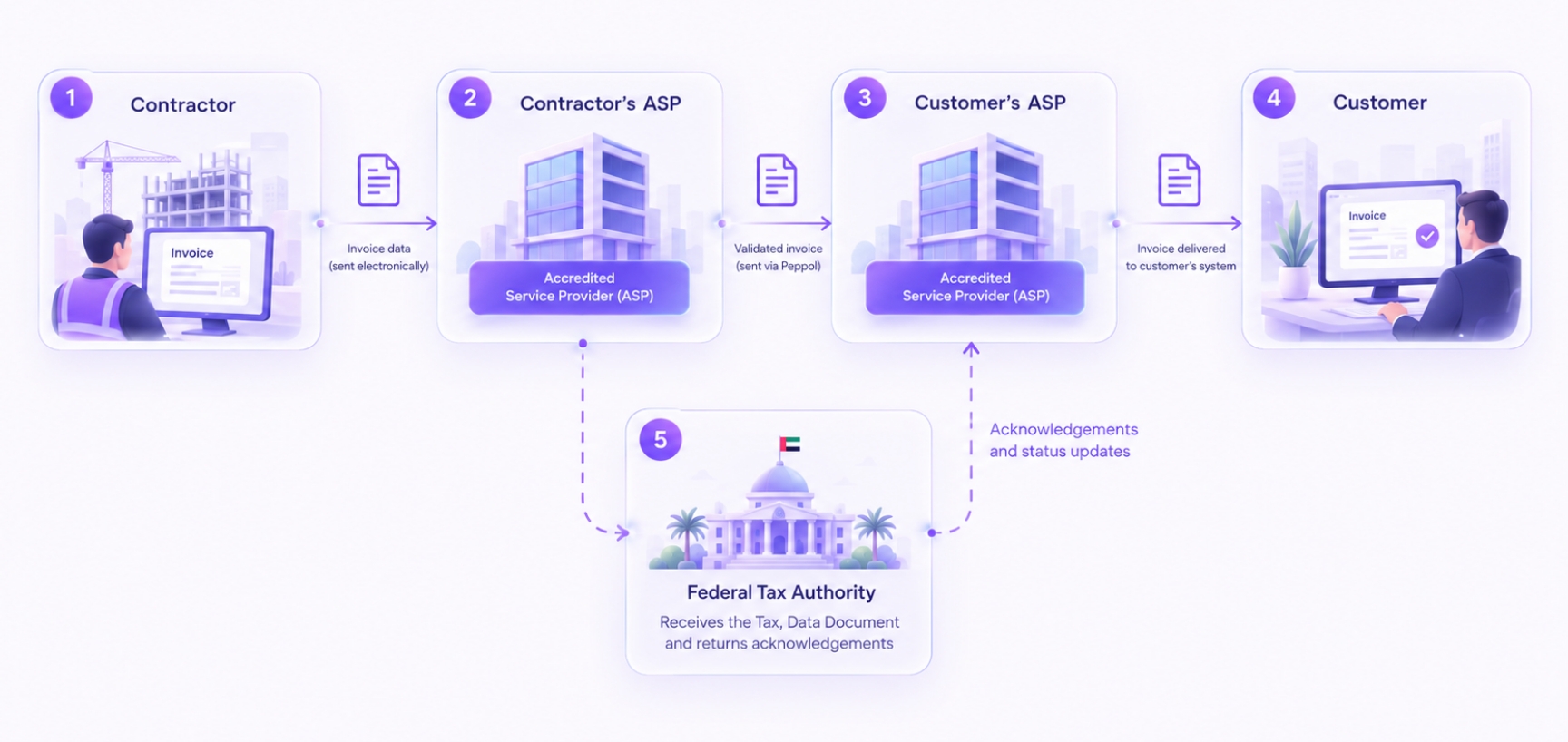
The UAE model has five corners.
- Corner 1 is the supplier, which creates the invoice data in its business system
- Corner 2 is the supplier's ASP, which validates the invoice, exchanges it and reports the tax data
- Corner 3 is the buyer's ASP, which delivers the invoice
- Corner 4 is the buyer, which receives it
- Corner 5 is the Federal Tax Authority, which receives the Tax Data Document and returns acknowledgements
The invoice moves along one path, from Corner 1 through the two providers to Corner 4. The tax data moves along another, from Corner 2 to Corner 5. Acknowledgements and statuses return to the sender's system, so finance can see whether an invoice was delivered or rejected.
A construction business sits at Corner 1 when it bills a client or developer and at Corner 4 when a material supplier or subcontractor bills it. Most contractors occupy both corners every day, so the ERP has to handle outbound and inbound invoices with the same project context.
Peppol, DCTCE, PINT AE and ASPs: What's the Difference?
These four terms often get used as if they mean the same thing. Each has its own job.
| Peppol | An international framework and network for exchanging electronic business documents | Carries the invoice between systems |
| DCTCE | The Decentralised Continuous Transaction Control and Exchange model, the UAE's version of the Peppol CTC model | Runs exchange and tax reporting together |
| PINT AE | The UAE customisation of the Peppol PINT specification, built on UBL 2.1 XML | Defines the fields and rules of the invoice |
| ASP | An ASP approved by the Ministry of Finance | Validates, exchanges and reports invoices for a business |
That's the relationship to remember. PINT AE defines the invoice. Peppol provides the exchange framework. DCTCE defines how the UAE operates the model. The ASP provides the connection.
What Does PINT AE Mean for a Construction Invoice?
PINT AE sets the structure and information required for an electronic invoice in the UAE. It covers details such as the supplier and customer's legal and tax information, invoice values, VAT details and the type of document being issued, including tax invoices and credit notes.
For a construction business, much of this information comes from the wider project and finance process. The invoice may be linked to a contracting entity, project, valuation, currency, retention or an approved variation. Payment certificates and subcontractor applications remain part of the project records, while the invoice carries the relevant billing and tax information.
The information also needs to be accurate before the invoice is submitted. If an invoice fails validation, the error is returned through the ASP and the invoice needs to be corrected before it can be exchanged.
That makes the ERP an important part of the process. Entity details, customer records, tax information and invoice data all need to be accurate at source.
How Does Peppol E-Invoicing Work With Construction Billing?
Construction invoices are tied to work, contracts and commercial approvals. Peppol changes how the resulting invoice is exchanged, while the underlying billing process still needs to account for valuations, retention, advances and variations.
Progress Billing and Valuation
Progress invoices are raised against certified work. The payment certificate remains part of the project records, while the tax invoice raised against the certified amount becomes the e-invoice. Keeping the invoice connected to the valuation gives finance teams a clear trail from certified work to the amount billed.
Retention
Retention affects the amount payable under a construction contract and therefore needs to be reflected correctly in the invoicing process. When retention is released, the related electronic tax invoice needs to remain connected to the earlier invoices so the transaction can be traced through the billing records.
Advance Payments
Advance payments also need to flow correctly into the invoicing process. A tax invoice is issued when the advance is received. When the final invoice is raised, it accounts for the amount already paid and references the earlier advance invoice.
Variations and Credit Notes
Approved variations can change the value of work being billed, so the revised amount needs to flow through to the relevant invoice. Credit notes handle adjustments to invoices that have already been issued. Referencing the original invoice keeps the adjustment linked to the transaction it relates to.
How Does Peppol E-Invoicing Handle Supplier and Subcontractor Invoices?
A main contractor sits at Corner 4 for every in-scope supplier or subcontractor invoice. The invoice arrives as structured data through the contractor's ASP, with the sender's identity, the amounts and the tax details already in it. Accounts payable receives a PINT AE file and creates or stages the payable in the ERP.
Receiving an invoice and approving it are separate steps.
Commercial review still applies, so the invoice is checked against the purchase order and delivery records for materials, and against the subcontract, the certified valuation and any approved variations for subcontract work. Supplier credit notes reference the invoice they adjust.
Where Does the Construction ERP Fit into Peppol E-Invoicing?
A construction ERP connects to an ASP, and the provider handles Peppol on its behalf. The usual route is an integration layer between the ERP and the provider, built on secure APIs. The ERP is the system at Corner 1 and Corner 4, so it creates outbound invoice data and receives inbound invoices.
Four points decide how well that connection serves a contractor:
- Field coverage: The ERP holds the legal identity, tax registration, VAT category and document type data that PINT AE requires
- Project context: Each invoice stays tied to its project, contract, valuation and certification records
- Status return: Submission, exchange and reporting statuses, errors and timestamps come back into the ERP, so finance can correct and resubmit
- Accountability: One team owns the full chain from ERP to integration to provider
Why Does Construction ERP Continuity Matter With Peppol?
Compliance is the floor, and many ERPs and providers clear it. The decision for a contractor is whether e-invoicing stays connected to how it bills, certifies and works with subcontractors.
A standalone compliance tool typically receives invoice data exported from the ERP. The project, contract, valuation and certification context stays behind, and finance ends up working across the ERP, the middleware and a separate provider portal. Continuity keeps that context on the invoice from creation to delivery and the status in the system finance already uses.
Xpedeon takes the second route. E-invoicing is ready in the core of the ERP, connected through managed APIs to an ASP and supported end to end by one team. Users create, approve and track invoices in Xpedeon screens and registers, submission runs through the managed ASP layer after approval and the statuses return to Xpedeon.
Conclusion
Peppol e-invoicing gives the UAE one standard way to exchange invoices, and PINT AE sets the data each one must carry. For construction businesses the detail sits in progress billing, retention, advances, variations and subcontractor invoices, all of which need structured data linked to the project. Appointing an ASP comes first, with dates set by revenue band.
Want to see how Peppol e-invoicing can fit into your construction ERP? Talk to an e-invoicing consultant today.