
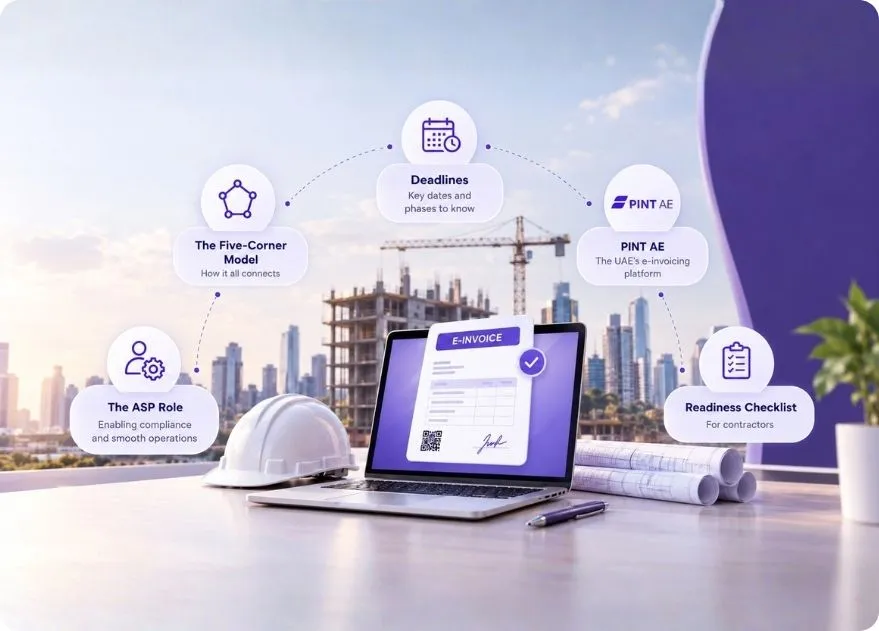
The UAE is moving towards a structured electronic invoicing system that will change how businesses issue, exchange and report invoices. For construction businesses, this means more than replacing paper invoices with digital documents. It requires the right invoice data, connected business systems and a clear process for meeting the new UAE e-invoicing requirements.
Under the UAE's e-invoicing framework, an emailed PDF is not enough. Businesses within scope must exchange structured electronic invoices through the prescribed system, using an Accredited Service Provider (ASP) and the UAE-specific PINT AE invoice format.
The transition is being introduced in phases, with mandatory implementation beginning in January 2027 for the first group of businesses. Contractors, developers and engineering, procurement and construction (EPC) companies need to understand which transactions are covered, when their obligations begin and what their existing finance systems must support.
This guide explains the UAE e-invoicing requirements, the implementation deadlines, the role of the Federal Tax Authority (FTA) and the practical steps construction businesses can take to prepare.
TL;DR: UAE E-Invoicing Requirements for Construction Businesses
- Issue and exchange structured electronic invoices. PDFs, scans and emailed attachments alone do not qualify.
- Use PINT AE, the UAE-specific invoice specification built on the Peppol framework.
- Understand the five-corner model connecting the supplier, supplier’s ASP, buyer’s ASP, buyer and Federal Tax Authority (FTA).
- Appoint an Accredited Service Provider (ASP) to facilitate invoice validation, exchange and reporting.
- Meet the applicable ASP appointment and mandatory implementation deadlines for each relevant business or legal entity.
- Determine which transactions fall within scope and whether any exclusions apply.
- Ensure customer and supplier master data, tax information, invoice fields and required identifiers are accurate and complete.
- Prepare systems for structured invoice data, validation, electronic exchange, reporting, status tracking and error handling.
- Review construction-specific billing processes, including progress billing, advance payments, payment certificates, retention, variations, credit notes and subcontractor invoices.
- Check the applicable currency, tax-data and record-retention requirements.
- Test the end-to-end invoicing process before mandatory implementation.
These requirements, implementation deadlines, and their implications for construction businesses are discussed in detail throughout this blog. Let’s dive deep into it.
What Is E-Invoicing in the UAE?
E-invoicing in the UAE changes what an invoice is and what information it must contain. Your system builds it as an XML file in the PINT AE format; an accredited service provider checks it and passes it to the buyer's provider, and the tax details reach the Federal Tax Authority (FTA) along the way. The Ministry of Finance (MoF) owns the framework, and the requirement phases in from 1 January 2027. For finance teams, it means less retyping at the receiving end. For the authorities, it means fewer gaps in VAT collection.
Why a PDF Is Not an E-Invoice
A PDF, scan, Word file or emailed attachment may look like an invoice to a person, yet none of them counts as an e-invoice. The XML file is the invoice, and software reads it field by field. In the meantime, a buyer who hasn't onboarded still needs a regular tax invoice, and the Guidelines expect it to travel alongside the e-invoice, which goes through the system as normal.
What Makes an Invoice an E-Invoice?
| Structured Data | Every value sits in a defined field, such as buyer identity, tax category and amounts |
| Standardised format | XML to the UAE specification, with no QR code or barcode |
| Electronic exchange | The invoice moves between the supplier's and the buyer's accredited service providers over Peppol |
| Validation | The ASP checks the data before the invoice travels |
| Reporting | Tax data reaches the FTA through the ASP, alongside the exchange |

Here's how the new flow runs in practice. The supplier's system sends invoice data to its ASP, which validates it and converts it to UAE XML if needed. The ASP then passes the invoice to the buyer's ASP and reports the tax data to the FTA at the same time. The buyer's ASP confirms receipt and delivers the invoice to the buyer, and confirmations flow back down the chain to the supplier.
Under the old flow, a wrong VAT category surfaced when the client's team queried it, often weeks later. Now validation sits before the client sees anything, so a missing field or a mismatched tax category comes back as a rejection at your end. The system checks structure, though, and a wrong retention figure or an unapproved variation will still pass if the fields are filled in correctly. The commercial accuracy of the number remains your job.
One more detail catches people out. Each business appoints a single ASP to handle both sending and receiving, so your AR and AP sides run through the same provider. The ASP does the transmission, yet the compliance obligation stays with the supplier.
How Does the UAE Five-Corner Model Work?
The UAE runs e-invoicing on a five-corner model. Two businesses never send invoices directly to each other. Each one connects through its own ASP, and the FTA receives the tax data. The MoF framework is the source for the terminology below.

Corner 1: Supplier
The supplier creates the invoice data in its business system, such as its ERP, and sends it to its ASP. The supplier calculates the invoice values and remains responsible for compliance.
Corner 2: Supplier's ASP
The supplier's ASP validates the data and converts it to UAE XML if it arrived in another format. It transmits the invoice to the buyer's ASP and reports the tax data to the FTA at the same time. Confirmations come back through it to the supplier.
Corner 3: Buyer's ASP
The buyer's ASP receives the invoice and validates it. It confirms the result to the supplier's ASP, then delivers the invoice to the buyer. If validation fails, it tells the supplier's ASP and the FTA, and no tax data is reported from that side.
Corner 4: Buyer
The buyer receives the invoice from its ASP in a format the two parties have agreed, then processes it in its own business system. In construction, that usually means the AP and commercial teams.
Corner 5: UAE tax platform (FTA)
The FTA receives the tax data and sends confirmations back to both ASPs. It sees the tax data, and the invoice itself travels only between the two ASPs.
Official reference: UAE eInvoicing, Ministry of Finance.
Who Must Comply with UAE E-Invoicing?
Under the UAE e-invoicing regulations, any person conducting business in the UAE falls in scope for every business transaction. VAT registration status alone does not determine whether a business falls within scope.
The exclusions are narrow: sovereign government activity, certain airline services and exempt financial services. None of them reaches a typical contractor. Goods and services supplied to government entities, including through tendered contracts, are covered.
Businesses with several legal entities should note two points. Each member of a VAT group onboards in its own right. Transactions between members of the same VAT group get a 24-month grace period from 1 January 2027, though every other transaction follows the normal timetable.
What the Rules Mean for Construction Businesses
Every link in the construction chain sits inside the system, and each one has a different job to do:
- General contractors issue e-invoices to developers and government clients and receive them from subcontractors and suppliers. They sit at both ends of the flow, so sending and receiving both have to work.
- Specialist contractors mostly invoice upstream to general contractors. Their phase depends on their own revenue, so they can go live months after the general contractor above them.
- Developers receive contractor and supplier invoices in volume. A developer that is a government entity follows the government timeline.
- EPC businesses that run several legal entities onboard each one separately, and each entity follows its own phase.
- Suppliers and subcontractors issue e-invoices once their own phase starts, whichever tier they sit in.
Three points apply to all of them:
- Each business is both an issuer and a recipient.
- Each business appoints one ASP to handle both sending and receiving.
- Phases follow each entity's own revenue, so a general contractor and its subcontractors can sit in different phases.
To know more about how it matters for construction and what it triggers for the sector commercially, read here - What Mandatory E-Invoicing Triggers for Construction.
UAE E-Invoicing Deadlines for Construction Businesses
The UAE is introducing mandatory e-invoicing in phases. For construction businesses, the applicable implementation date depends primarily on the organisation's annual revenue and whether it falls within the relevant category of entities covered by the rules.
| Business to business (B2B) | Yes |
| Business to government (B2G) | Yes |
| Government to business (G2B) | Yes |
| Government to government (G2G) | Yes |
| Business to individual consumers | Yes |
The exclusions are narrow: sovereign government activity, certain airline services and exempt financial services. None of them reaches a typical contractor. Goods and services supplied to government entities, including through tendered contracts, are covered.
Businesses with several legal entities should note two points. Each member of a VAT group onboards in its own right. Transactions between members of the same VAT group get a 24-month grace period from 1 January 2027, though every other transaction follows the normal timetable.
What the Rules Mean for Construction Businesses
Every link in the construction chain sits inside the system, and each one has a different job to do:
- General contractors issue e-invoices to developers and government clients and receive them from subcontractors and suppliers. They sit at both ends of the flow, so sending and receiving both have to work.
- Specialist contractors mostly invoice upstream to general contractors. Their phase depends on their own revenue, so they can go live months after the general contractor above them.
- Developers receive contractor and supplier invoices in volume. A developer that is a government entity follows the government timeline.
- EPC businesses that run several legal entities onboard each one separately, and each entity follows its own phase.
- Suppliers and subcontractors issue e-invoices once their own phase starts, whichever tier they sit in.
Three points apply to all of them:
- Each business is both an issuer and a recipient.
- Each business appoints one ASP to handle both sending and receiving.
- Phases follow each entity's own revenue, so a general contractor and its subcontractors can sit in different phases.
To know more about how it matters for construction and what it triggers for the sector commercially, read here - What Mandatory E-Invoicing Triggers for Construction.
UAE E-Invoicing Deadlines for Construction Businesses
The UAE is introducing mandatory e-invoicing in phases. For construction businesses, the applicable implementation date depends primarily on the organisation's annual revenue and whether it falls within the relevant category of entities covered by the rules.
| AED 50 million or more annual revenue | 30 October 2026 | 1 January 2027 |
| Below AED 50 million annual revenue | 31 March 2027 | 1 July 2027 |
| Government entities | 31 March 2027 | 1 October 2027 |
Source: UAE Ministry of Finance, including the 2026 amendment to the implementation timeline. Businesses should consult the latest official decisions for their circumstances.
The MoF amended the first ASP appointment deadline from 31 July 2026 to 30 October 2026. The implementation date of 1 January 2027 remains unchanged.
What These Deadlines Mean for Contractors
A contractor in the first implementation phase should prioritise its ASP appointment, data assessment, integration planning and end-to-end testing. A smaller specialist contractor with a later date should still use the additional time to prepare its records and processes rather than waiting until implementation approaches.
Businesses working on public-sector projects should also establish which obligations apply to them in their own capacity. A government customer does not, by itself, determine the implementation phase of every contractor or supplier involved in the project.
What is PINT AE and What It Means for Construction?
PINT AE stands for Peppol International Invoice UAE. It is the UAE-specific invoice specification built on the Peppol framework and Universal Business Language (UBL) standards, with additional requirements for the UAE. It defines how invoice information is structured so that participating systems can interpret and validate it consistently.

Why PINT AE Matters to Your Business System
An invoice that looks right on screen can still fail validation. What matters is the data underneath: legal identity, tax category, document type, currency and the references that tie one document to another. So, the useful question for your ERP is whether it can produce the structured data UAE e-invoicing requires.
One practical limit applies. Businesses can’t add their own optional fields to PINT AE, so anything industry-specific has to be agreed with your ASP.
What is an Accredited Service Provider (ASP) and What does it do?
An ASP is a provider accredited by the MoF to run e-invoicing for businesses. Its work covers:
- Validation. It checks your invoice data against the UAE specification.
- Conversion and processing. It converts data to UAE XML where needed and generates a unique identifier for every invoice.
- Transmission and exchange. It sends the invoice securely, encrypted, to the buyer’s ASP, after looking up the buyer’s participant identifier.
- Reporting and statuses. It reports tax data to the FTA and passes confirmations back to you.
| Calculating invoice values | Supplier |
| Gathering the buyer’s Peppol participant identifier | Supplier |
| Secure, encrypted transmission | ASP |
| Generating a unique identifier for each invoice | ASP |
| Compliance obligation | Supplier (or buyer, for self-billed invoices) |
The last row matters. The ASP does the transmitting, but the obligation to comply stays with the business that issues the invoice.
The next steps are to select an ASP, complete the required onboarding, integrate your systems, and test the end-to-end process. You choose one ASP from the MoF’s list of accredited providers, finalise the contract, and start onboarding yourself through EmaraTax, because the process begins with the business, not the provider. After that you connect your systems to the ASP and test the full exchange. Each business appoints a single ASP for both sending and receiving. Your participant identifier comes from your tax identification number, which is the first ten digits of your TRN.
Construction Invoicing Scenarios That Need Attention
UAE e-invoicing requirements: the construction data chain from contract to payment
A payment certificate is the commercial truth of a construction invoice. Payment certificates are based on measured progress, assessed against the contract and its terms. E-invoicing leaves all of that in place. It changes how the resulting invoice data has to be structured, validated and exchanged, so the weak points tend to sit upstream. Finance often inherits a rejection that started in the commercial team’s records.
| Progress billing and payment certificates | Advance payments need a tax invoice when received, and the final invoice then covers only the balance. Charges such as the Dubai Municipality construction surcharge have their own field |
| Retention | The Guidelines accept an invoice for the amount payable after retention, then a separate e-invoice when the buyer becomes liable to release it |
| Variations | The contract value field has to be updated in the first invoice issued after the project value changes. Provisional amounts are adjusted with a credit note or an additional invoice |
| Credit notes and adjustments | Credit notes can be partial and can reference several earlier invoices. The Guidelines list invoices and credit notes as the document categories, so confirm with your ASP how debit-type adjustments are handled |
| Subcontractor invoices | Each subcontractor issues its own e-invoice once its phase starts, and your AP team needs a way to receive them through your ASP. Self-billing needs the buyer to be on the system |
| Multi-currency transactions | The gross amount payable must appear in AED, converted at the Central Bank approved rate, with a tax accounting currency field when the invoice currency differs |
For the full technical requirements, refer to the UAE Electronic Invoicing Guidelines published by the Ministry of Finance.
How Should Construction Businesses Prepare for UAE E-Invoicing?
Preparation should start with the information and processes that create an invoice instead of just the system that transmits it.
1. Confirm your implementation phase
Check your annual revenue against the AED 50 million line, then note your ASP appointment date and go-live date. Do it for each legal entity.
2. Check your master data
Customer, supplier and tax information has to be complete and consistent. Customer records also need the buyer’s Peppol participant identifier, which the supplier is responsible for gathering. Most teams find old supplier records take longer to clean than the ASP takes to appoint.
3. Map where invoice data comes from
Follow each data point back to its source:
- commercial: certificates, variations and reverse-charges
- project: contract values and progress
- procurement: orders, commitments and supplier invoices
- finance: tax categories, currency and ledgers
4. Review construction billing scenarios
Walk through progress claims, retention, variations, credit notes and subcontractor invoices, and decide how each one will appear in structured form. The table above can be a good starting point for that.
5. Assess your ERP and integration requirements
Ask four questions of your system:
- Can it generate structured invoice data?
- Can it connect with an ASP?
- Can it receive status and error information?
- Can it maintain an audit trail? Taxable persons keep e-invoice records for five years after the tax period.
6. Allow time for testing
Having an invoice system and being ready for UAE e-invoicing are two different states. Testing closes the gap. Run invoices from your system to the ASP, through delivery to a buyer, back to confirmations, and include the tax data reporting step.
UAE E-Invoicing Readiness Checklist for Construction
Regulatory
- ☐ We know which implementation phase applies to us
- ☐ We know our ASP appointment deadline
- ☐ We understand which transactions are in scope
Data
- ☐ Customer and supplier data is accurate
- ☐ Tax information is complete
- ☐ Required invoice information is available in our systems
Construction processes
- ☐ Progress billing is mapped
- ☐ Payment certificates are accounted for
- ☐ Retention is understood
- ☐ Variations are accounted for
- ☐ Credit notes and adjustments are mapped
- ☐ Subcontractor invoicing is covered
Systems and Testing
- ☐ Project, contract, procurement and finance records can support invoice preparation
- ☐ Required data can be mapped and validated against the specification
- ☐ The ASP integration and exchange process have been planned
- ☐ Finance can see processing statuses and errors that need attention
- ☐ Invoice records stay linked to the contract and the commercial transaction
- ☐ End-to-end testing has been scheduled
Why Construction-Specific ERP Readiness Matters
Invoicing in construction rarely stands alone. A contractor preparing an application may need an approved payment certificate, a contract milestone or an earlier invoice in front of them, and when those records sit in different systems, someone reconciles them manually before the invoice goes out.
A construction ERP can keep those records connected, provided the set-up covers:
- connected records, with project, contract, procurement, approval and accounting data linked to each invoice
- configuration against the UAE e-invoicing specification
- integration with the ASP
- validation before submission
- end-to-end testing
- operational controls, including approvals, status tracking and error handling
Xpedeon follows this connected approach, keeping invoicing tied to project, contract, procurement and approval records, with submission through a managed accredited service provider.
The wider test is continuity. E-invoicing should fit the way your business already manages contracts, subcontractors, procurement and project finances, with no extra disconnected process for finance to maintain.
Explore Xpedeon's UAE e-invoicing readiness to understand how the transition can fit into a connected construction business system.