
Sending an invoice is usually the easy part. The work before that can be more complicated.
The project team needs to confirm how much work has been completed. The commercial team checks the contract value. There may be an approved variation since the last application. Retention may need to be deducted, and any advance payment may need to be adjusted.
If this information sits in different places, finance has to bring it together before the invoice can be issued.
This becomes more important as e-invoicing changes how invoice information is submitted and processed. The invoice still needs to reflect the correct commercial position, but the data behind it also needs to be accurate and consistent.
So, when choosing construction invoicing software, it is worth looking beyond the ability to create and send an invoice.
Can the software handle the information and processes behind it?
7 Areas Construction Invoicing Software Should Cover
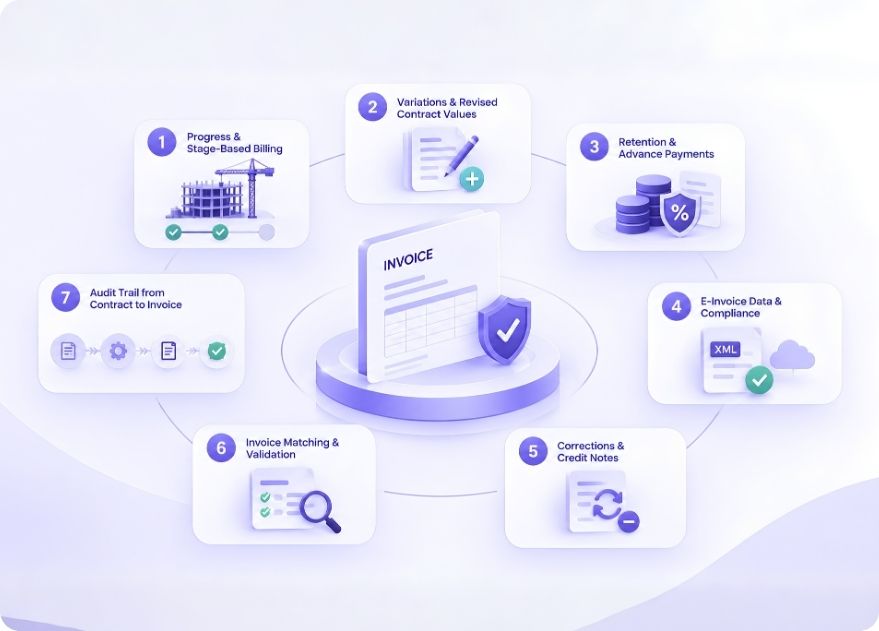
From the first progress update to the final invoice, several checks can affect what a contractor bills and how that invoice is processed. Here are seven areas to consider when assessing whether your software can support the full billing process.
1. Progress and Stage-Based Billing
Construction businesses do not all bill in the same way. Some invoices are based on work completed during a particular period. Others are linked to project milestones or stages. Some contracts require work to be measured and certified before an invoice can be raised.
Take a contractor working on a phased development. One stage may be almost complete while some work is still outstanding. The amount being billed needs to reflect the actual position.
The software should support billing based on project progress and the terms of the contract. It should also make it easy to see what has already been billed and what remains to be invoiced. That matters when teams are managing several projects at once.
Xpedeon supports project-based operations alongside financial accounting and contract management, giving construction businesses a connected environment for managing these processes.
2. Variations and Revised Contract Values
A variation can change the amount a contractor is entitled to bill. The difficulty comes when the variation is recorded in one place and the invoice is prepared somewhere else. For example, a client approves additional work midway through a project. The commercial team updates the contract records, but the next invoice is still prepared using the original value.
The variation may not need to be invoiced immediately. The important thing is that the latest approved contract information is available to the people preparing the bill. This is where a connected process can help. The person preparing an invoice should be able to see relevant changes to the contract without relying on an email or a separate spreadsheet.
Xpedeon's contract and change order capabilities support the management of variations alongside contract values, budgets and cost-to-complete information.
3. Retention and Advance Payments
Retention can make construction billing harder to keep track of. A contractor may deduct retention across several applications and release it later when the relevant conditions have been met. Advance payments may also need to be recovered through future invoices.
If these figures are recorded separately, the billing team has to check previous applications and financial records each time an invoice is prepared.
They may need to establish:
- How much retention has been deducted?
- How much has been released?
- How much advance payment has been recovered?
- What adjustment should appear on the current invoice?
Construction invoicing software should make these figures easier to follow as part of the project and financial records. That saves teams from going back through old invoices and spreadsheets every time they need to establish the current position.
4. Structured E-Invoice Data and Compliance Requirements
This is where e-invoicing has a direct impact on the billing process. An invoice is often treated as a document. Create it, turn it into a PDF and send it to the customer. E-invoicing can require invoice information to be created, exchanged and processed in a structured format. That makes the quality of the underlying data important.
Depending on the relevant requirements, invoice information may include:
- Customer details
- Invoice references
- Tax information
- Transaction values
- Project or contract references
- Payment details
The exact requirements vary between countries and e-invoicing frameworks. Our separate article on mandatory e-invoicing triggers for construction covers the wider regulatory changes.
For contractors evaluating software, the practical question is different:
Can the system produce accurate invoice information from the records already held in the business?
If finance has to re-enter details from spreadsheets or other systems before an electronic invoice can be processed, the technology has not removed the underlying manual work.
5. Invoice Corrections and Credit Notes
An invoice can need changing after it has been prepared or issued. A certified value may be revised. A quantity may have been entered incorrectly. A contract adjustment may affect the amount. Tax information may also need to be corrected.
The important part is how the change is recorded.
If teams overwrite the original information or manage corrections through email, it can become difficult to establish what happened later. Construction invoicing software should provide a clear way to manage corrections, adjustments and credit notes while keeping the original transaction visible.
Teams should be able to answer simple questions:
- What was originally invoiced?
- What changed?
- Why did it change?
- Who approved the adjustment?
That information can save time when dealing with client queries, account reviews or audits.
6. Invoice Matching and Validation
An invoice should be checked against the information that supports it. For supplier invoices, that might mean checking the invoice against a purchase order and goods receipt. For other construction transactions, the relevant records may include contract details, approved values or project records. The exact checks will depend on the transaction.
The important thing is to catch differences before they become part of the financial record. For example, an invoice might contain a value that does not match the purchase order. A quantity might differ from what was received. A tax detail could be missing or incorrect. Without a proper validation process, someone has to spot these differences manually.
Xpedeon's platform supports supplier invoice integration with ERP, including invoice validation and audit-ready invoice exchange. Its wider procurement capabilities also cover purchase orders, receipts and supplier processes.
For contractors handling a high volume of supplier and project transactions, this kind of checking can take a significant amount of manual work out of the process.
7. A Clear Audit Trail from Contract to Invoice
When someone asks why an invoice was raised for a particular amount, the supporting information should be easy to find. It may include the contract, project progress, certification, approved variations and previous billing.
A typical process could look like this:
Contract → Project Progress → Certification → Approved Variation → Billing → Invoice → Financial Record
The exact process will vary between projects. What matters is that teams can follow the transaction and understand how the final invoice amount was reached. This can also help when dealing with client queries, commercial disputes and audits.
Xpedeon's platform brings contract management, project controls, financial accounting, workflows and audit trails together within a construction-focused environment.
What Contractors Should Consider When Evaluating Software
The invoice itself is only one part of the decision. When comparing construction invoicing software, contractors should look at what happens before and after an invoice is created.
Ask:
- Can the system support the billing methods used across our contracts?
- Can approved variations be reflected in the billing position?
- Can we track retention and advance payments?
- Can invoice information support the relevant e-invoicing requirements?
- Can the system manage corrections and credit notes?
- Can invoices be checked against the records behind them?
- Can we trace an invoice back to the transaction that created it?
There is another practical consideration: how much work will still sit outside the system?
If the process requires teams to maintain spreadsheets for variations, separate records for retention and email chains for approvals, the invoice may still depend on manual reconciliation even when the final document is produced electronically.
For larger contractors managing multiple projects, entities and supply chain relationships, those workarounds can become difficult to maintain. Xpedeon's positioning is built around bringing commercial, finance and supply chain workflows together in one construction-focused platform.
How Xpedeon Construction ERP Fits into the Picture
The seven areas all point to the same issue: an invoice depends on information from across the project.
With Xpedeon, these processes can sit within one construction ERP environment:
- Financial accounting: Manage the financial records behind project billing.
- Accounts Payable and Receivable: Manage customer and supplier invoices within the wider financial process.
- Project controls: Keep billing connected to project budgets, progress and financial performance.
- Contract and change order management: Keep approved contract changes and variations visible to the billing process.
- Procurement: Connect purchasing and supplier information with the financial records that support it.
- Retention management: Track retention as part of the wider contract and billing process.
- Invoicing: Manage client invoicing within the same construction-focused platform.
- Approvals and workflows: Give teams structured processes for reviewing and approving transactions.
- Audit trails and reporting: Maintain a clear record of transactions and provide visibility across the business.
- E-invoicing integration: Support electronic invoice exchange as part of the wider ERP environment.
The advantage is the connection between these areas. A change to a contract can affect billing. Project information can support the amount being invoiced. Procurement records can help with supplier invoice checks. Approvals and audit trails sit around the transaction rather than being managed separately.
That is the role Xpedeon is designed to play: a purpose-built construction ERP that brings financial, commercial and operational processes together.
If your teams are still bringing billing information together from separate systems, explore how Xpedeon can connect your construction financial and project processes →